
We Checked 1,156 Water Damage Companies: More Reviews Will Not Make You Number One
Every restoration owner we speak to has been told the same thing: get more reviews and Google will move you up. So we checked whether that is true.
We pulled Google’s local results for water damage restoration in 30 US cities and recorded where every business ranked, how many reviews it had, its star rating, how long it had been trading, whether it had a website and whether it advertised 24 hour cover. That gave us 1,156 businesses. Here is what the numbers say.
Reviews do matter, and then they stop
The first finding supports the conventional advice. Businesses in the top three have a median of 92 reviews. Those sitting between positions 11 and 20 have 56. There is a real gradient, and it runs the way you would expect.
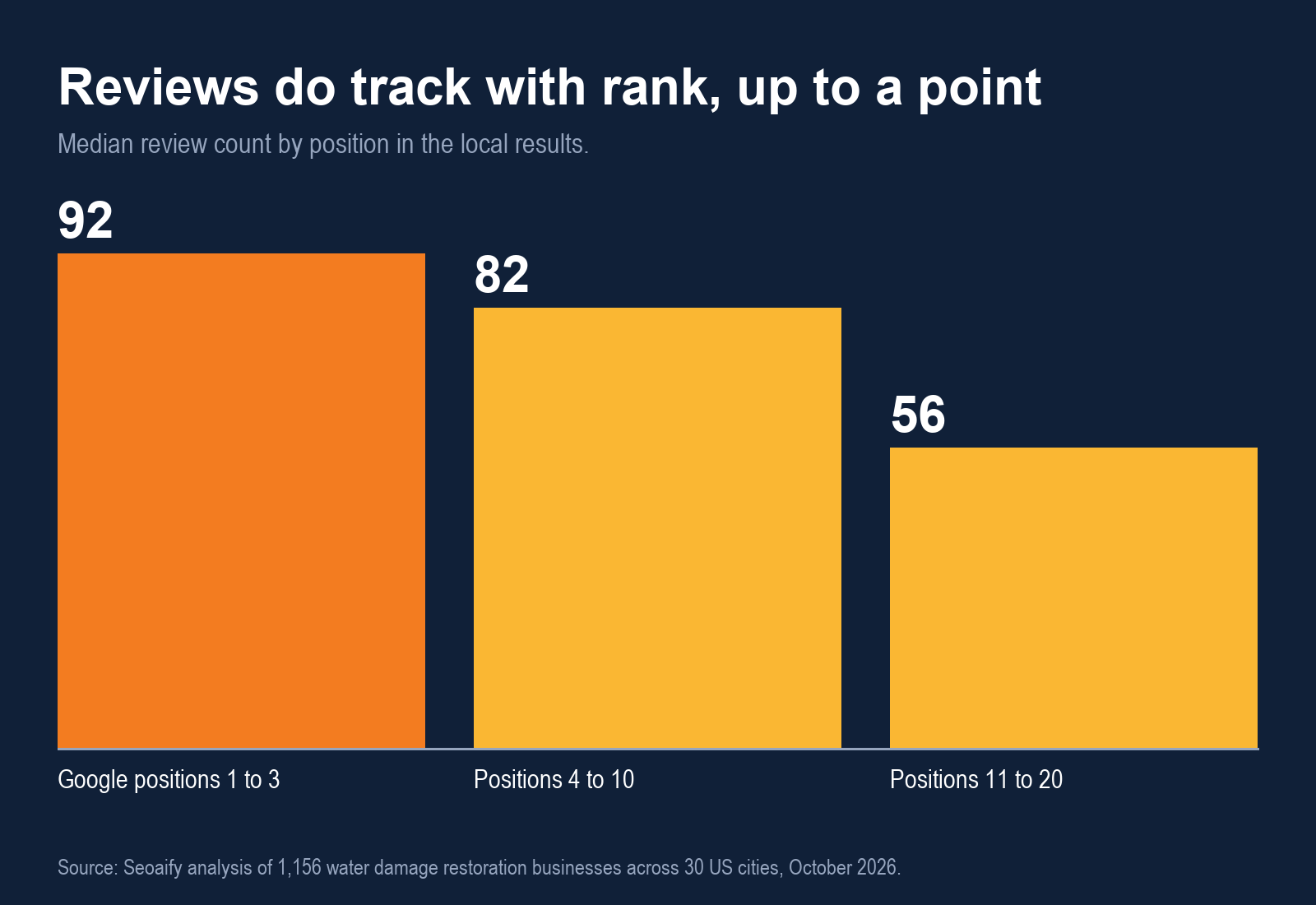
So if you have nine reviews and your competitors have ninety, that gap is worth closing. Reviews are part of how Google decides you are a real business worth showing.
The trouble starts when you assume the relationship keeps going. It does not.
In 26 of 30 cities, the review leader is not number one
We asked a simple question of each city: does the business with the most reviews hold first place? The answer was yes in four cities out of thirty.
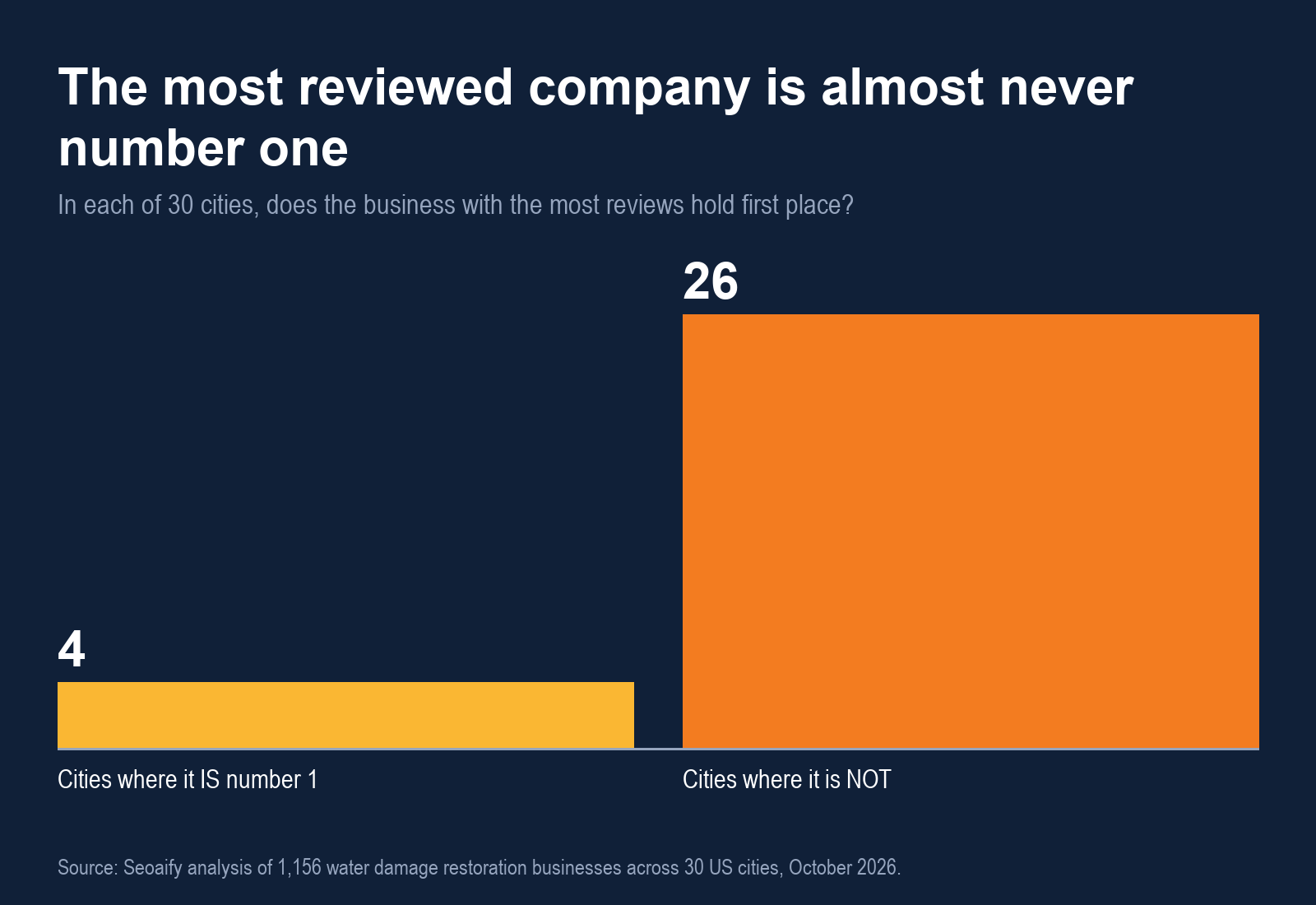
Four out of thirty is close to what you would get by chance. Whatever is deciding first place, it is not the review count, because the company with the most reviews loses it almost every time.
Fresno is the clearest example
In Fresno, the business holding first place has 57 reviews. Further down the same results page, at position 20, sits a company with 3,700.
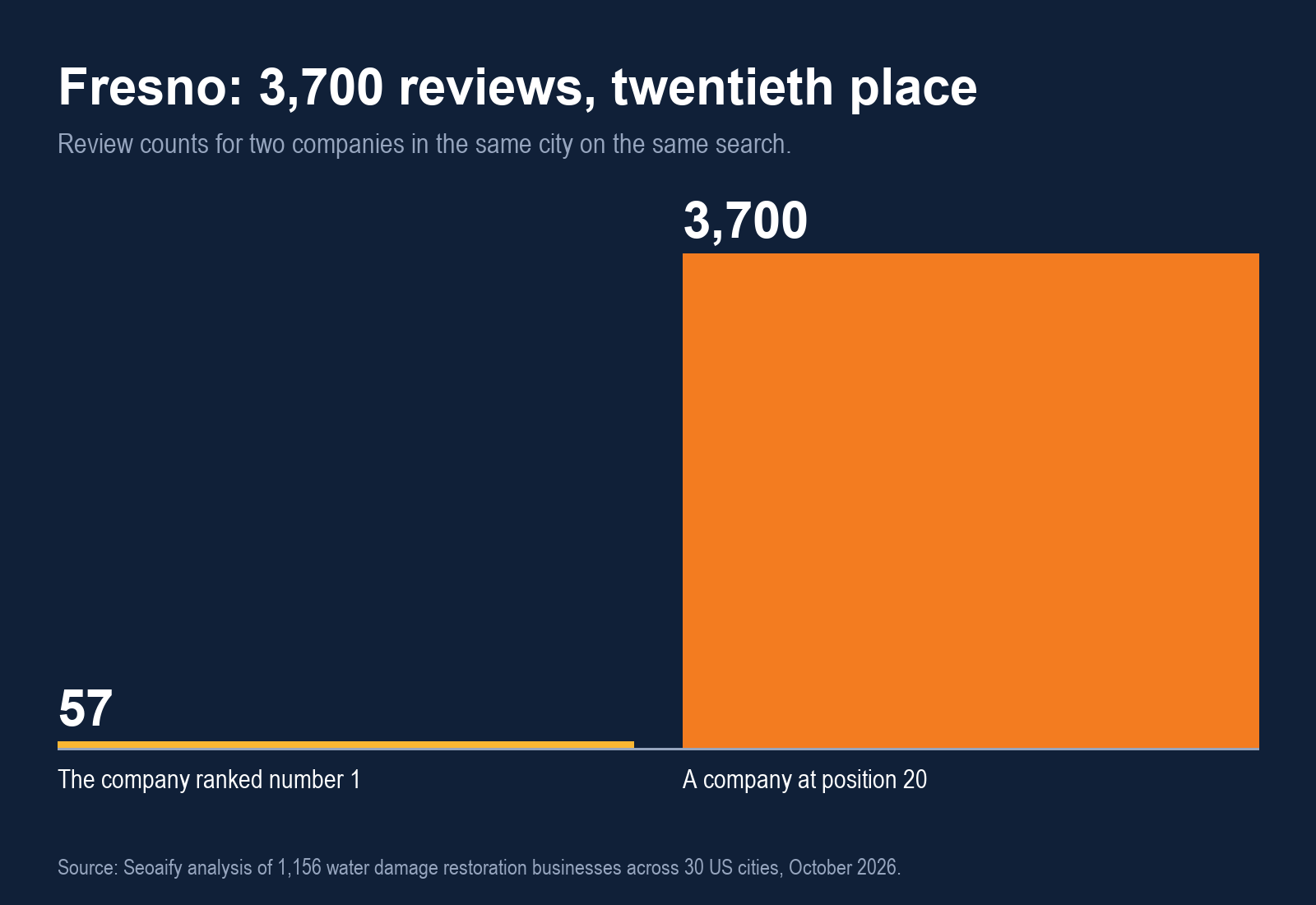
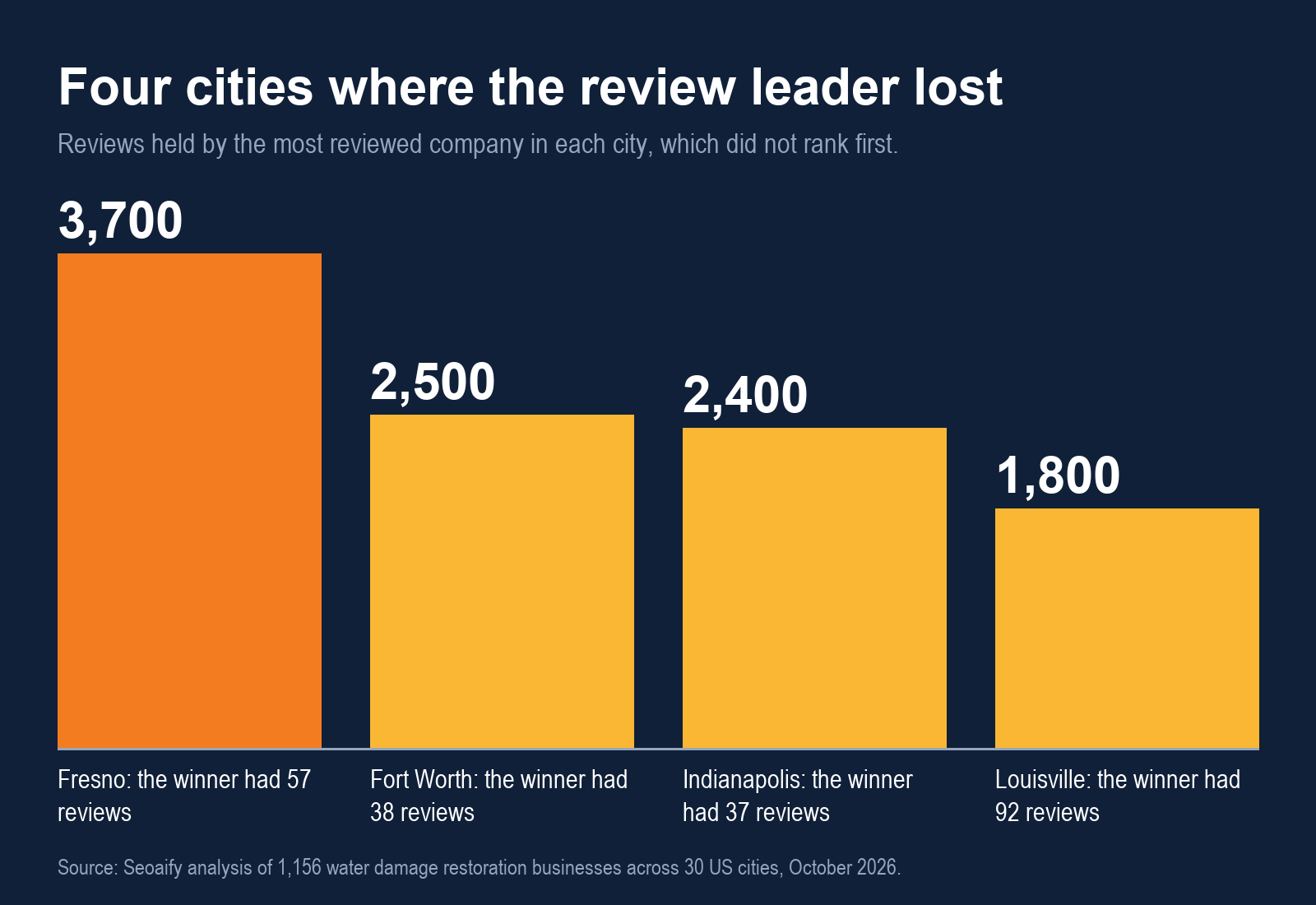
That company has sixty five times the social proof and it is nineteen places behind. It is not an isolated case. In Fort Worth the winner had 38 reviews while a business with 2,500 sat at position nine. In Indianapolis the winner had 37 against a rival with 2,400 at position eighteen. In Austin, first place had eleven reviews.
The things everyone optimises are identical
If reviews are not the deciding factor, the obvious next question is what else differs between the winners and everyone else. In our data, almost nothing does.
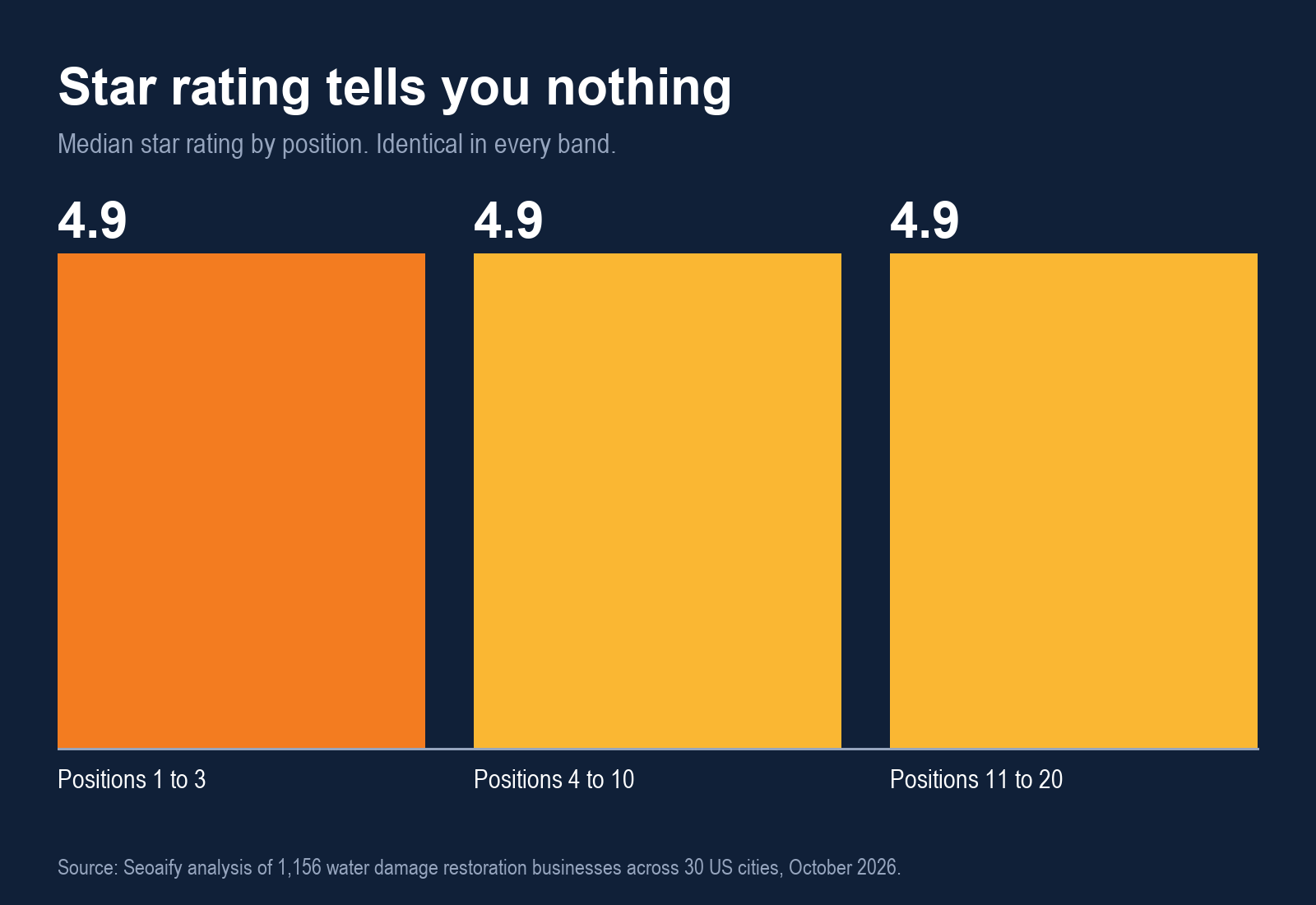
Median star rating is 4.9 whether a business is in the top three or down at position twenty. Not close to identical. Identical.
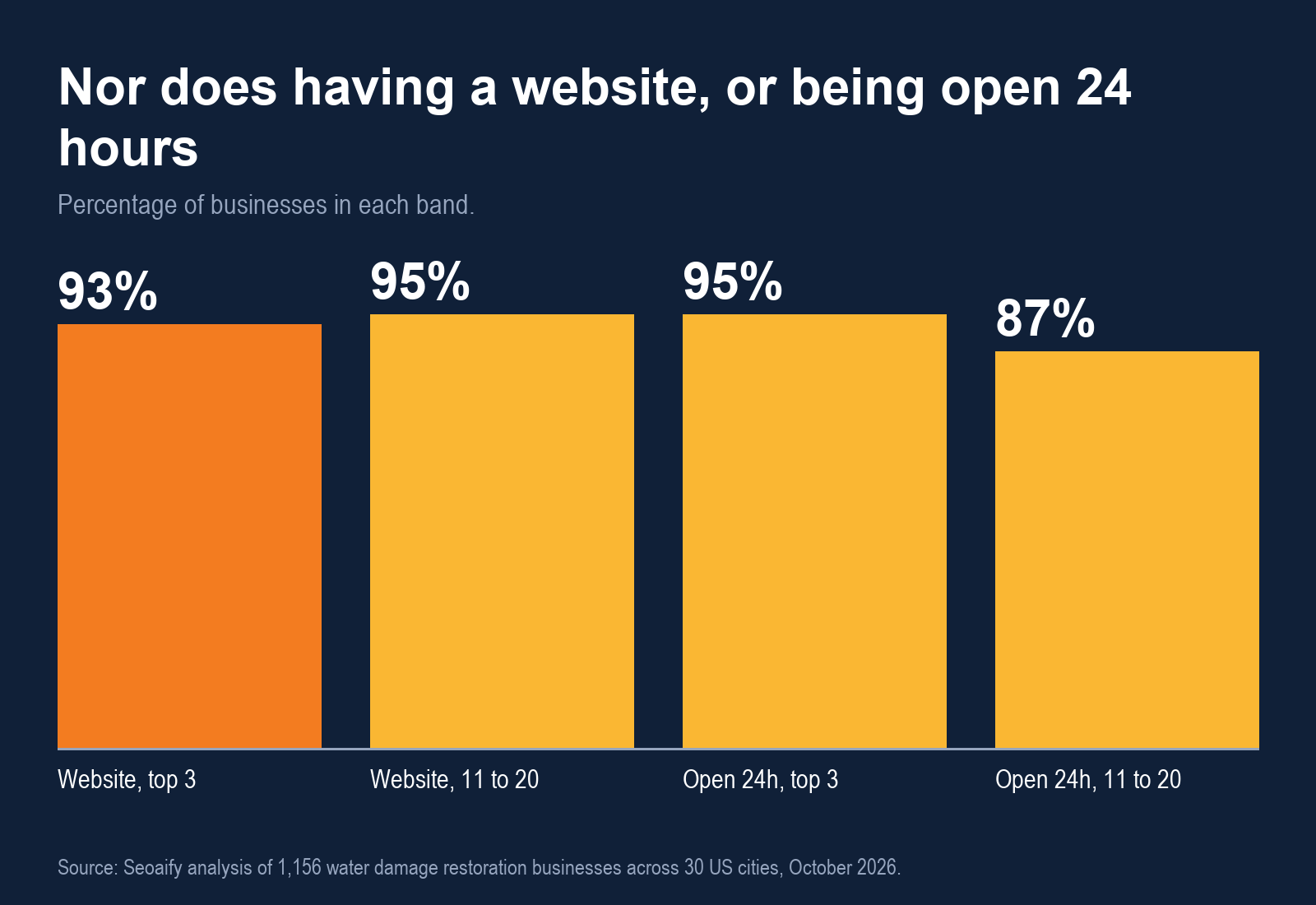
Median years in business is ten across every band. Having a website is near universal and very slightly more common outside the top three than inside it, 95 percent against 93. Advertising 24 hour cover is the only measure with any daylight at all, 95 percent of the top three against 87 percent further down, and that is a modest difference on a measure almost everyone already meets.
What this means if you are trying to move up
The honest reading is that reviews, ratings, longevity and having a website are table stakes. They get you considered. Once every business in the results has 4.9 stars, ten years of history and a website, none of those can be what separates first place from twentieth.
What is left is the part nobody enjoys: the profile itself. Primary category, the service list, the service area, whether the business name matches the signage, opening hours that are actually filled in, photos with real location data, questions answered, posts that are not three years old. These are unglamorous and they are the only variables still moving once everyone has the same star rating.
There is a second reading too, and it is less comfortable. Proximity to the searcher is a large part of the local algorithm and you cannot optimise your way out of your own address. Some of the gap between first and twentieth is simply where the van is parked. That is worth knowing before you spend another year chasing reviews you were never going to convert into position.
How we did this
We recorded Google’s local results for water damage restoration across 30 US cities in October 2026, capturing position, review count, star rating, years in business, website presence and advertised hours for every business returned. After removing duplicates we had 1,156 distinct businesses. Medians are used throughout because review counts are heavily skewed by a small number of very large firms.
Two limitations worth stating. Local results vary by the searcher’s exact location, so a single capture per city is a snapshot rather than an average. And this is a correlation study of one trade in one country: it tells you what the top three have in common, not what caused them to get there.
If you want to know which of these actually applies to your own listing, that is what we do. We rebuild one restoration profile a week at no charge to prove the point.

One Comment