
Google Now Gives You 4 Days to Reject an Edit to Your Listing
Google now gives you four days to reject a stranger’s edit to your Google Business Profile. Miss the window and Google may publish the change itself, as long as something public, like your own website, appears to back it up. For restoration companies that advertise round the clock cover, a single unnoticed change to your hours now costs money as well as rankings.
What actually changed
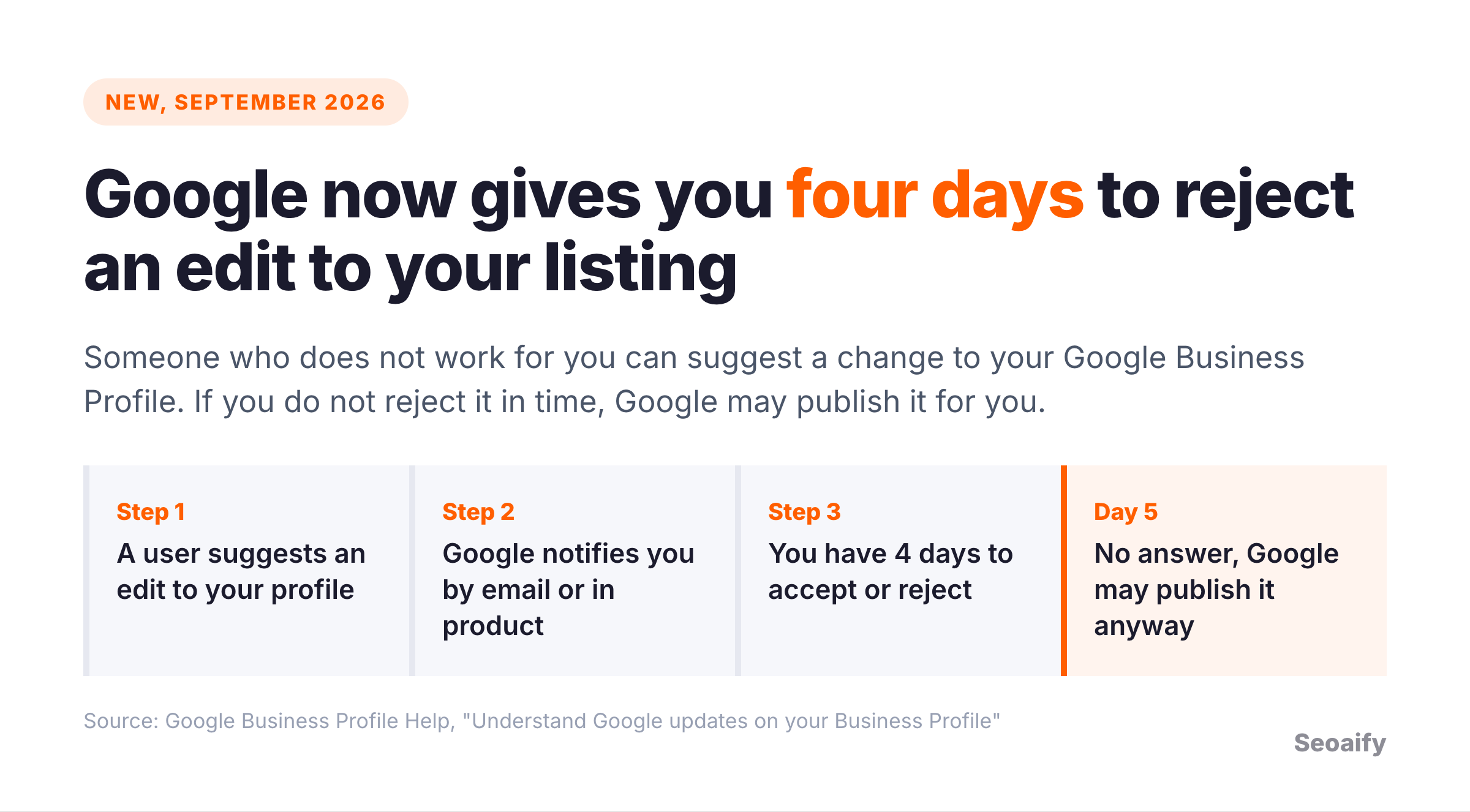
Google updated the help page “Understand Google updates on your Business Profile” in late September 2026. Barry Schwartz picked it up on Search Engine Roundtable on 23 September. The wording is short and worth reading carefully, because the second sentence is the one that matters.
“Once notified, you have 4 days to accept or reject the suggestion. If you don’t respond within 4 days, Google may automatically publish the update if it is supported by other publicly available information, such as your business website.”
Google Business Profile Help, Understand Google updates on your Business Profile
User suggested edits are not new. Anyone with a Google account has been able to propose a change to any listing for years. What is new is a published deadline, and an explicit statement that silence can count as consent.
There is a second line on the same page that gets less attention:
“Google may apply suggested user edits to your business information without prior review. This happens in cases where edits must meet policy guidelines.”
Google does not list which edits those are. So some changes arrive with a four day clock, and some arrive with no clock at all.
Why this lands harder on restoration than on most trades
A restaurant with a fixed address and fixed hours has a small surface area here. A business that travels to the customer has a large one, because more of its profile is made up of fields a stranger can plausibly get wrong.
We have the numbers for this. In September 2026 we mapped the local results for water damage restoration across 30 US metros and recorded the details of every listing Google showed.
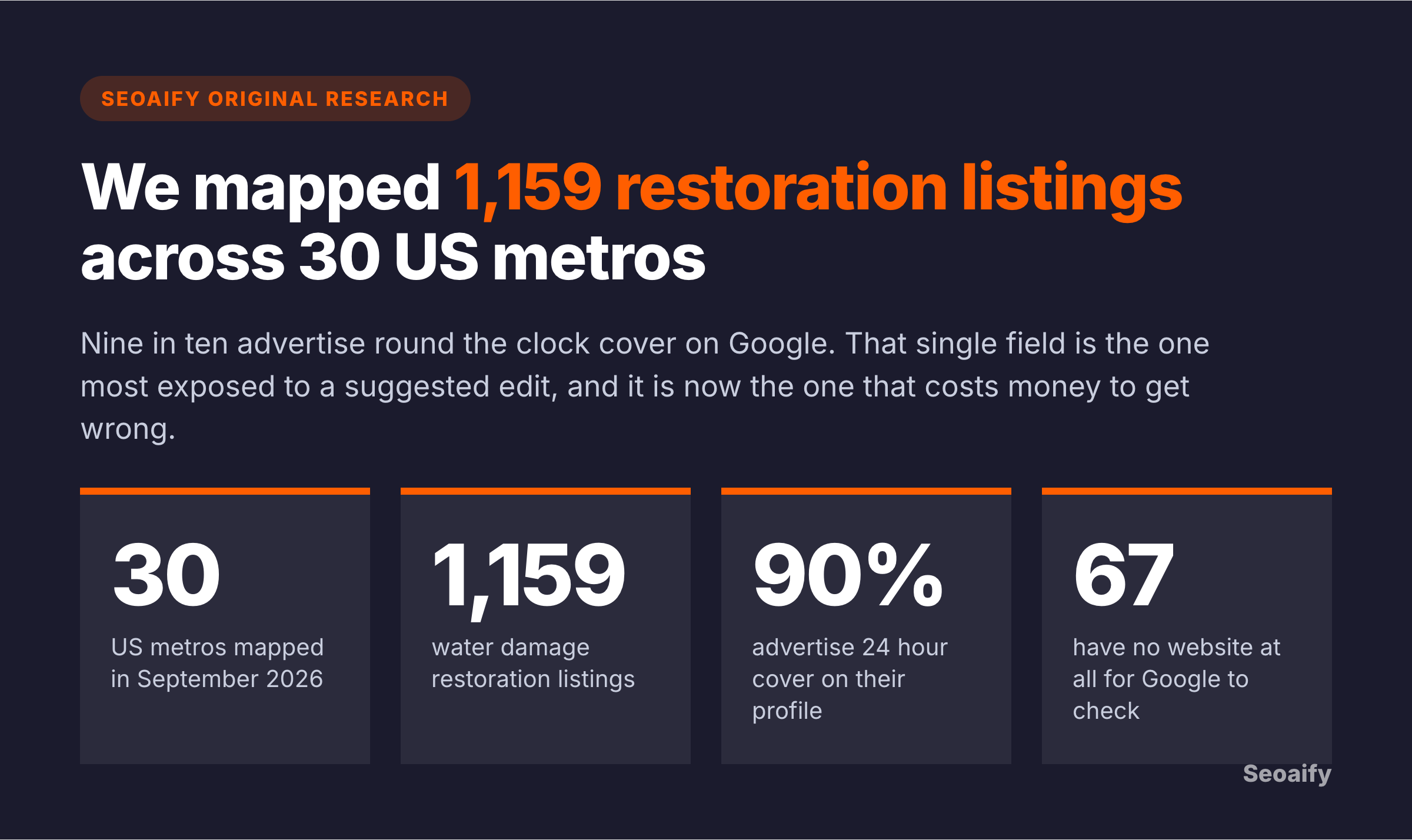
Of 1,159 unique listings, 1,045 advertise 24 hour cover. That is 90 percent of the trade resting on one field that a suggested edit can change. And 67 of those businesses have no website at all, which matters more than it looks, for reasons we will come to.
The fields worth protecting
Not every edit is a problem. A corrected spelling is fine. These six are the ones that change whether the phone rings.
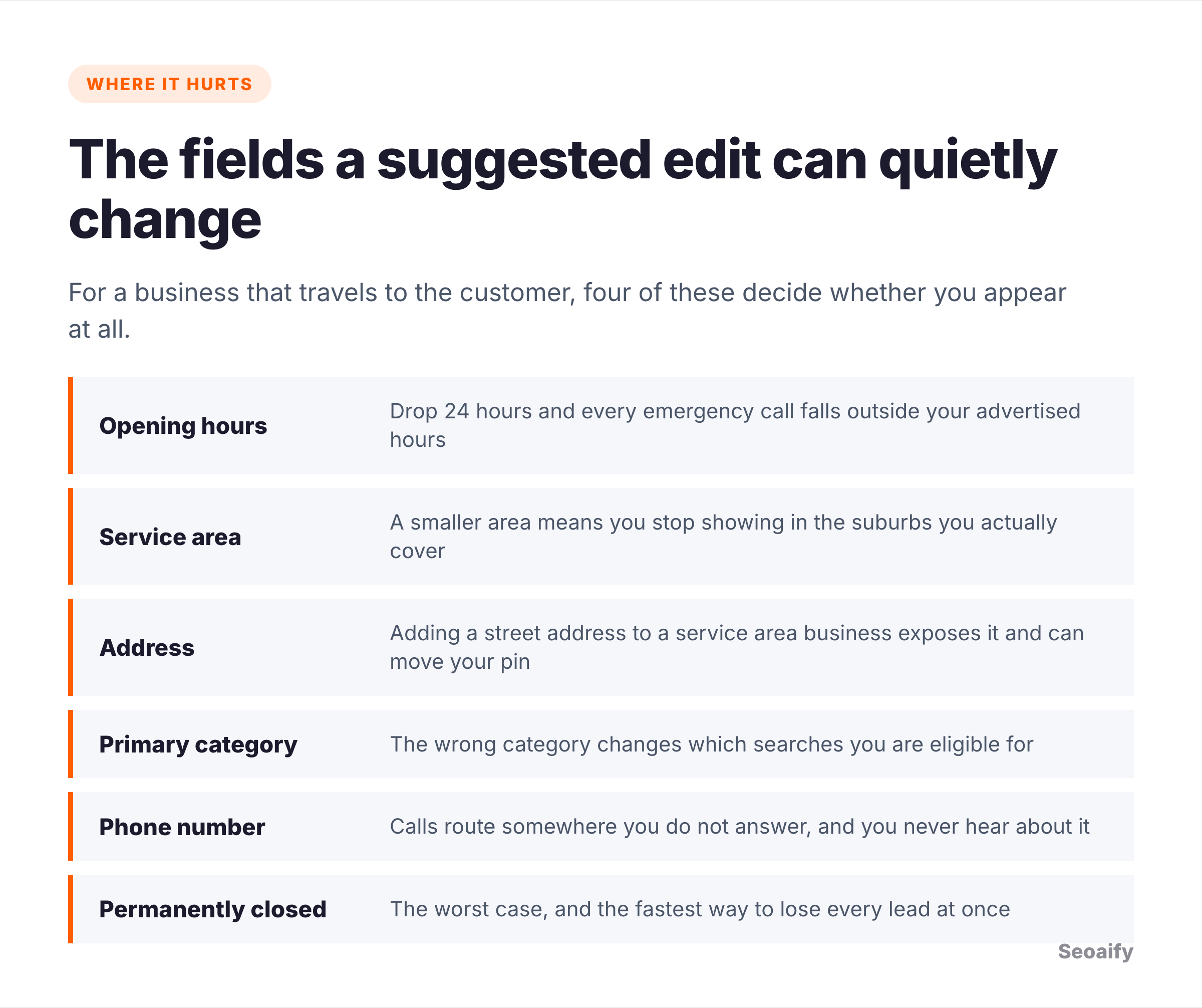
Opening hours is the big one, and not only for the obvious reason. From 1 October 2026 Google charges Local Services advertisers for calls nobody answers, when the caller waits past 20 seconds during your advertised business hours. We wrote about that change when it was announced. Your advertised hours are now a billing input, not just a display field.
Service area is the quiet one. Nobody gets an alert saying “you stopped appearing in Chandler”. You just get fewer calls, and you assume the market went soft.
Address matters because service area businesses deliberately hide theirs. An edit that adds a street address undoes that choice, and it can move your map pin. We have written separately about service area pins ending up in open water, which is a related failure with the same root: the profile says something about your location that you never said.
The part most people miss: your website is the tiebreaker
Read Google’s sentence again. It does not say the edit gets published because four days passed. It says it may be published if it is “supported by other publicly available information, such as your business website”.
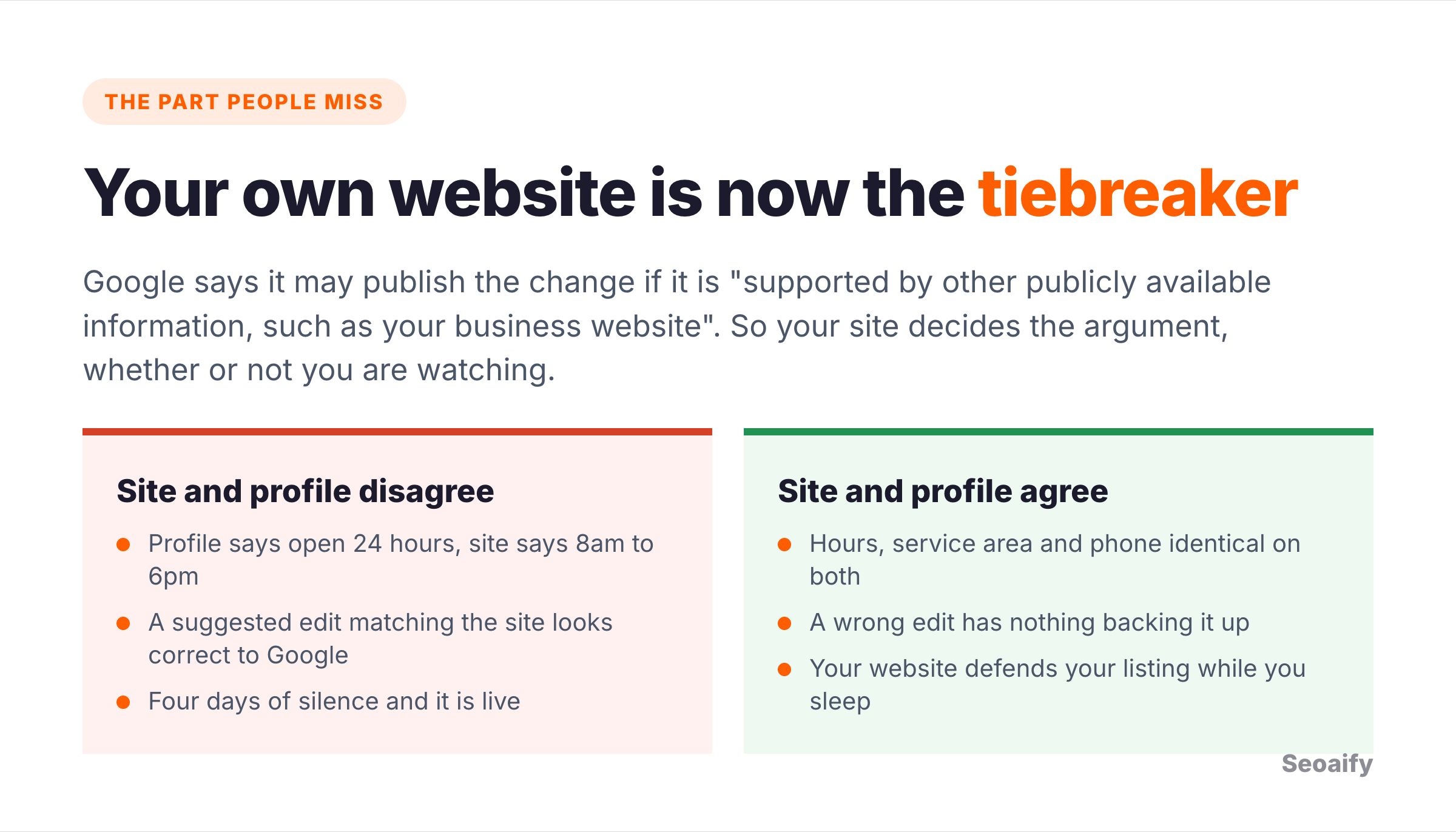
So your website is now evidence in an argument you are not present for. If your profile says open 24 hours and your contact page says 8am to 6pm, a stranger suggesting “this place is not really open at night” has your own site backing them up.
This is where those 67 listings with no website come in. No site means no corroborating source, which cuts both ways: there is nothing to support a wrong edit, and nothing to defend you either. If that is you, the fix is not subtle. A business competing for emergency work with no website in 2026 has a bigger problem than suggested edits.
Four days is shorter than it sounds
Four days is not four working days. A suggestion that lands on Thursday evening expires before Monday morning, and this trade does not sit at a desk. Crews are on jobs. The notification goes to whichever email was used when the profile was claimed, which is often a shared inbox, sometimes a former employee’s, occasionally an address nobody has opened since 2021.
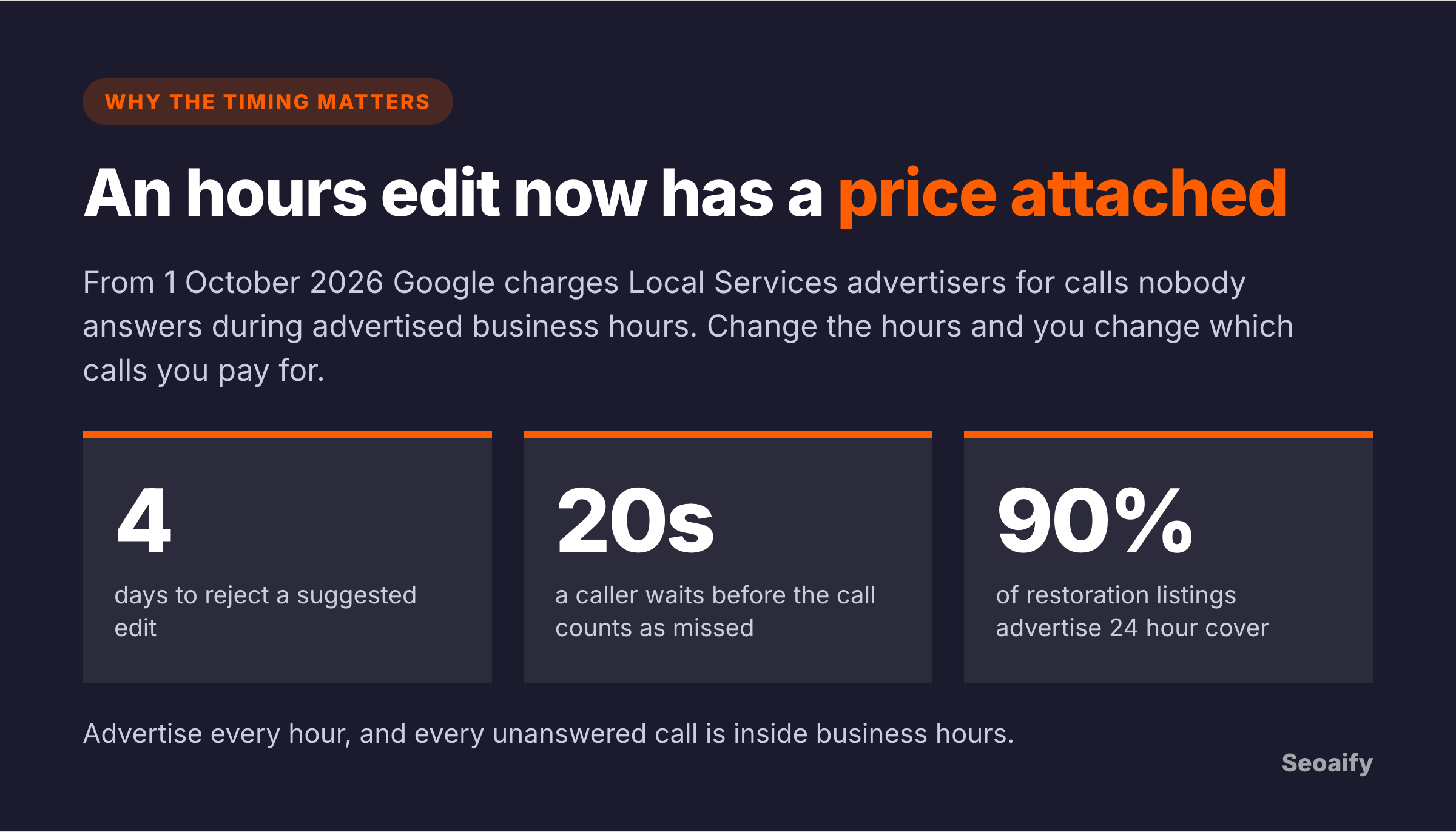
Put the two 2026 changes together and the failure mode is easy to describe. Someone edits your hours down from 24 hours. You do not see the email. Four days later it is live. Your Local Services ads keep running, calls keep arriving at 2am, and now every one of them sits inside your advertised hours as far as billing is concerned, while your team was never expecting to answer them.
What to do about it
None of this needs a tool or a subscription.
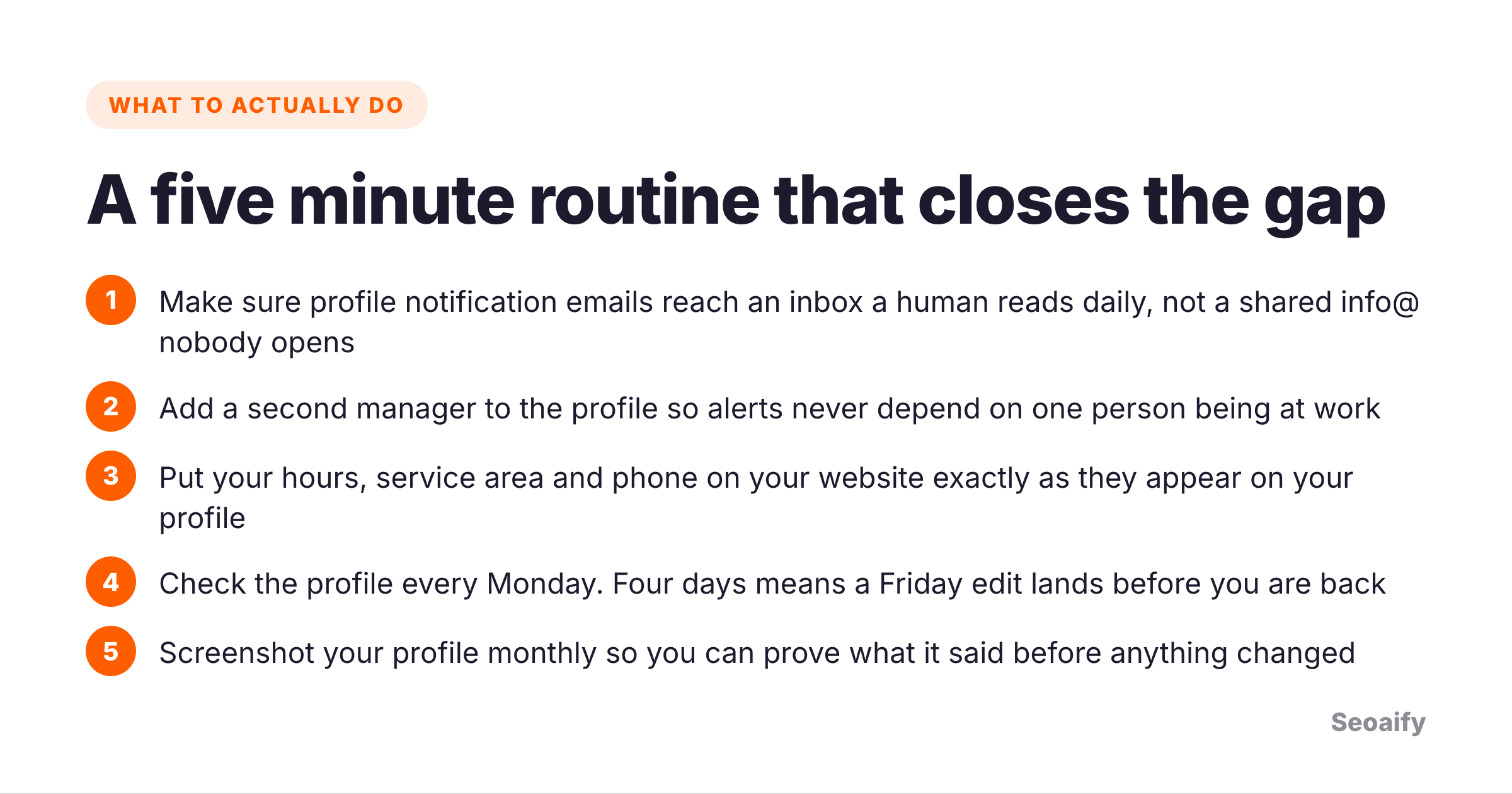
Check where the notifications go. Sign in to the profile and look at the contact email. If it is a shared inbox, add someone who reads it daily.
Add a second manager. One person on holiday should not mean four days of silence. This is free and takes a minute.
Make your website agree with your profile. Hours, service area and phone number, stated in plain text, matching exactly. This is the highest value item on the list, because it is the thing Google checks.
Look at the profile every Monday. Four days means a Friday edit lands before you are back. A Monday glance catches the damage early even when you miss the alert.
Screenshot the profile monthly. If you ever need to argue a change back, having a dated record of what it said is worth more than your memory of it.
Frequently asked questions
Can anyone really edit my Google Business Profile?
Anyone with a Google account can suggest an edit. They cannot change it directly in most cases. What changed in September 2026 is that ignoring the suggestion is no longer a safe way to refuse it: Google says it may publish the change after four days if other public information appears to support it.
Will Google tell me when someone suggests a change?
Google says you may get an email or an in product notification when a suggested edit needs your review. It also says some edits can be applied without prior review, so notification is not guaranteed for every change.
How do I reject a suggested edit?
Open your Business Profile while signed in as an owner or manager, find the notification or the pending update, and choose to reject it. Doing it inside the four day window is what stops the automatic publication.
What happens if a bad edit goes live?
You can change the information back yourself as the owner. The damage is the gap between the edit going live and you noticing, which is exactly what a weekly check shortens.
Does this affect Local Services Ads?
Indirectly, and expensively. Your advertised hours decide which unanswered calls Google charges you for under the policy that took effect on 1 October 2026. An edit to your hours changes what you pay for.
The short version
A field on your Google listing can now be changed by someone who does not work for you, and your silence counts as agreement after four days. The single most useful thing you can do this week is make your website say exactly what your profile says, because that is the evidence Google weighs when you are not there to argue.
If you would rather someone watched this for you, that is part of what we do, and our restoration specific plans exist because this trade keeps hitting problems the generic advice never mentions.