
Google Starts Charging for Missed Calls on 1 October, and Restoration Companies Will Feel It First
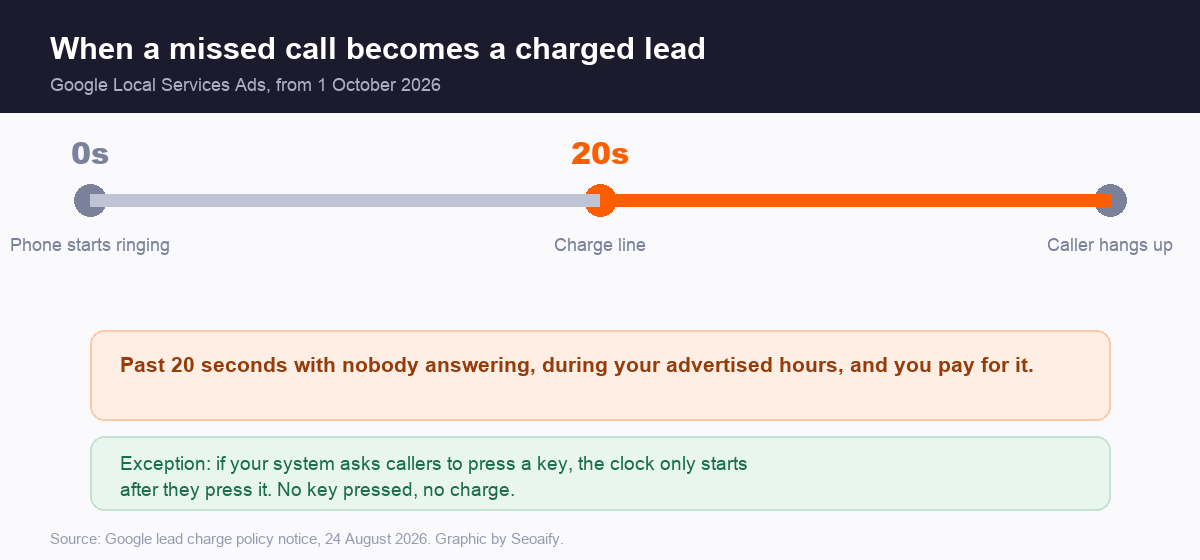
From Thursday 1 October, Google starts charging Local Services advertisers for calls nobody answers. If a caller reaches your line during your advertised hours and waits longer than 20 seconds without a person picking up, that becomes a billable lead. You pay for the call you missed. For a trade that sells 24 hour emergency response, this lands harder than it will anywhere else.
What Google actually changed
Google emailed Local Services advertisers on 24 August with a notice headed “Upcoming changes to lead charge policy”. Until now a phone call only became a charged lead if somebody answered it or the caller left a voicemail. From 1 October, an unanswered call can be charged on its own.
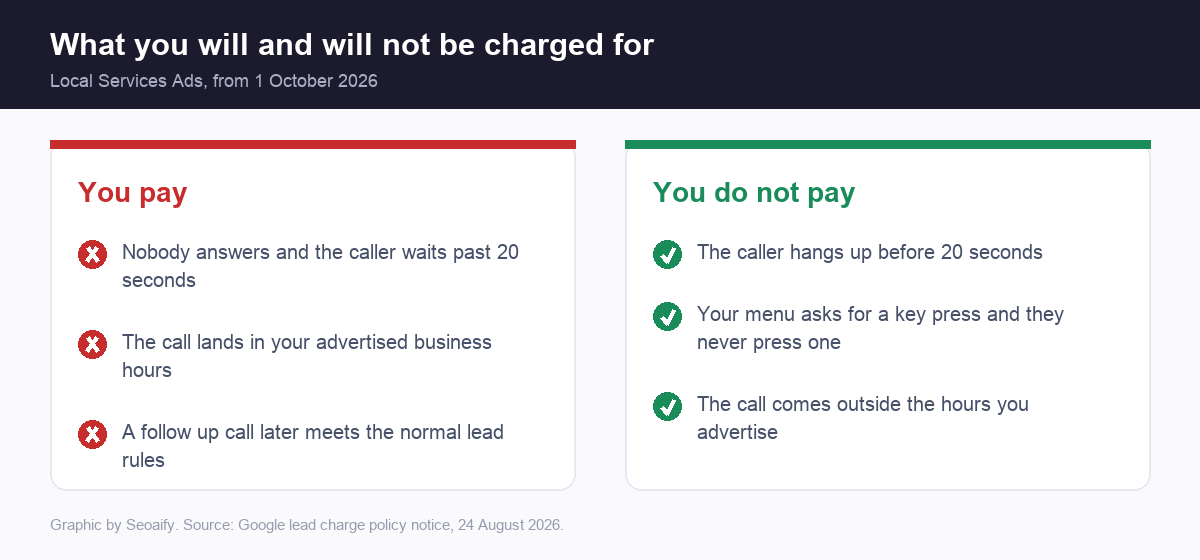
Three conditions have to line up. The call has to arrive inside the business hours you advertise. Nobody answers it. And the caller stays on the line for more than 20 seconds. Miss all three and nothing happens. Hit all three and it costs you the same as a real lead.
There is one exception worth knowing, and it is the most useful sentence in the whole notice. If your phone system asks callers to press a key before routing them, the 20 second clock does not start until they press it. A caller who never chooses an option is never charged for.
Google also said that if a first call does not qualify as a charged lead, a later follow up call between you and that person will be charged if it meets the normal lead rules. So a missed call is not simply written off.
Google’s own framing is that the change rewards businesses that answer. That is a fair description of the intent. It is also a fair description of a policy that transfers the cost of a ringing phone from Google to you.
Why restoration gets hit harder than any other trade

A dentist advertises nine to five and answers nine to five. The exposure is small. Restoration is the opposite: the entire pitch is that you pick up when a pipe bursts at two in the morning, and the whole industry says so on its profile.
We went and counted. In our September analysis of Google’s local results for water damage restoration, 35 of the 40 listings we mapped in Phoenix advertise round the clock availability, and 37 of the 38 in Austin do. Almost nobody in this trade advertises office hours.
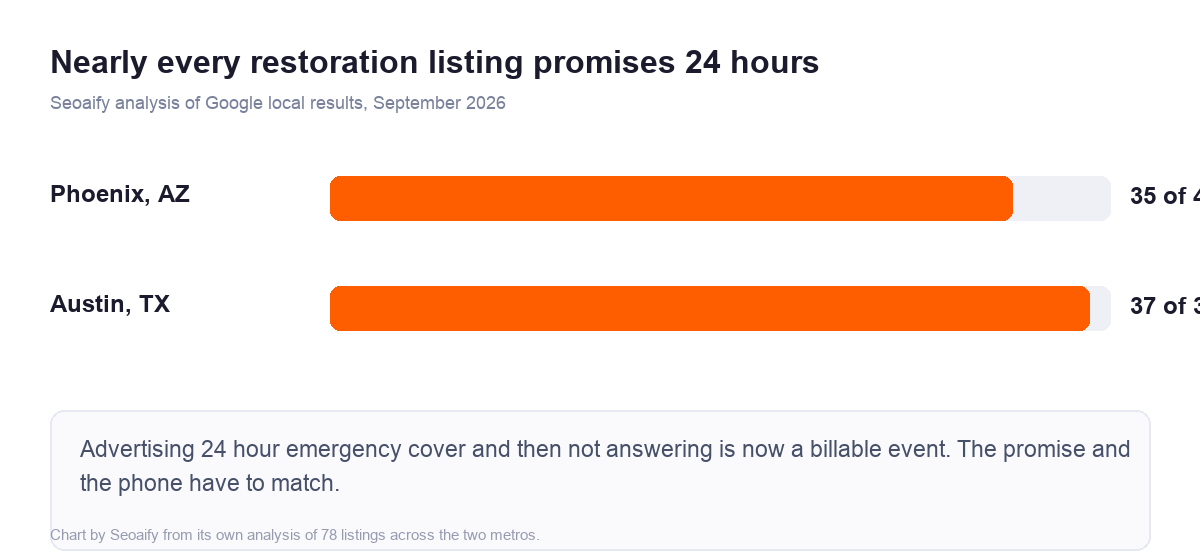
That matters because “advertised business hours” is the trigger. If your profile says you are open 24 hours, then every hour is business hours, and every unanswered 3am call past 20 seconds is billable. The promise you made to win the ranking is now the promise you get invoiced against.
Then there is the shape of the work. Restoration demand does not arrive evenly. A freeze event or a storm puts forty calls into a nine hour window, which is exactly when a small crew is least able to answer the phone. The week you are busiest is the week you will miss the most calls, and now that is also the week you pay the most for missing them.
And the numbers are not small. Restoration is one of the most expensive categories in the system. Industry reporting puts Local Services leads for restoration around $215 each, with search campaigns in competitive metros running from $600 to $1,400 per lead. Three missed calls on a bad Saturday is real money.
The second change nobody is talking about

Since the start of September, advertisers have been reporting that Local Services Ads are showing the phone number from the Google Business Profile rather than the tracking number set in Google Ads, even when the call assets are configured correctly. Google has confirmed the behaviour twice and has not reverted it. Separately, some Local Services accounts detached from the Business Profiles feeding them on 1 September, which Google called a bug.
Put those together with the missed call charge and the position is uncomfortable. You are about to start paying for calls you did not answer, at the same moment the reporting that would tell you which calls came from where has quietly stopped working properly. If you have been judging your Local Services spend on call tracking data, check that the data still says what you think it says.
What to do before Wednesday
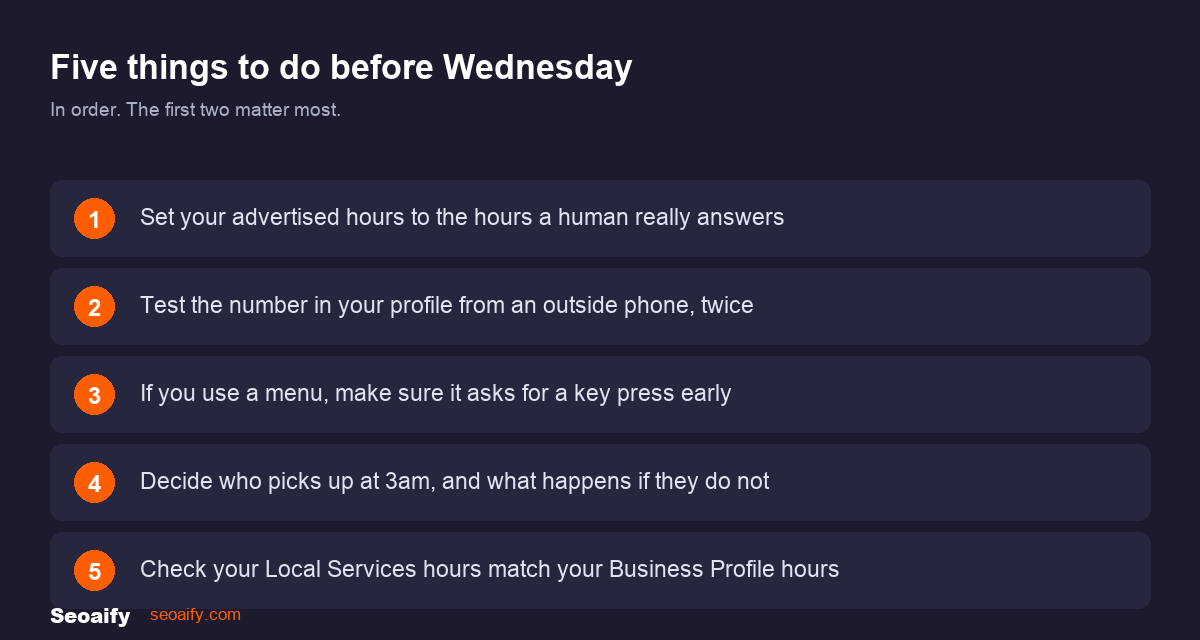
None of this requires a strategy meeting. It requires an afternoon.
Make your advertised hours honest. This is the whole ballgame. If there is genuinely nobody answering between midnight and six, then advertising 24 hours is now a standing bill rather than a selling point. Either staff it properly, put an answering service on it, or change the hours. Plenty of restoration firms will lose less by advertising the hours they really cover.
Ring your own number from an outside phone. Twice, at different times, including once at night. You are checking two things: that the number on the profile is the one that actually reaches somebody, and how long it takes before a human speaks. If it takes more than 20 seconds, you have found your problem.
Use the key press exception properly. If you run a menu, make sure the prompt comes early and clearly. The clock does not start until the caller presses a key, which converts a risky dead ring into a free one. This is the single cheapest protection in the policy.
Decide who owns the 3am call. Not in principle, by name. A rota, a forwarding rule, an answering service with your script. The businesses that will do well out of this change are the ones that already had an answer to that question.
Check your hours match in both places. Local Services hours and Google Business Profile hours are set separately and drift apart. While you are in there, it is worth a look at the rest of the profile too, since most of the fields that drive ranking are the ones people leave blank.
The wider point
This is the second policy change in a month that punishes restoration companies for habits the industry taught itself. In the spring Google rewrote its review rules and made per review technician bonuses and scripted review requests explicit violations, which we covered in our breakdown of the 2026 review rules. Now it is charging for the emergency calls that go unanswered.
Both changes point the same way. Google is steadily removing the gap between what a business advertises and what it actually delivers, and it is willing to charge you for the difference. The companies that come out of this ahead are not the ones with the cleverest ad setup. They are the ones whose profile is honest and whose phone gets answered.
If it helps to see where you actually stand, that is the free audit we run: your Map Pack position, who is above you, and what it would take to replace one of them. We do it for restoration companies specifically, including in Phoenix and Austin.
Questions restoration owners are asking
Does this apply to Google Ads or only Local Services Ads?
Only Local Services Ads, the pay per lead product with the green Google Guaranteed badge. Standard Google Ads campaigns bill per click and are unaffected by this change.
What if the call goes to voicemail?
Google’s notice does not spell out how voicemail is treated, and that is one of several details it left open. Assume a call that rings past 20 seconds and then hits voicemail is chargeable until Google says otherwise.
Can I dispute a charge for a missed call?
Google did not announce a new dispute route with this change. The existing lead dispute process in the Local Services dashboard is what you have, and disputing a call you genuinely did not answer is a harder argument than disputing a wrong number.
Should I just turn off 24 hour availability?
Only if you genuinely do not cover those hours. Availability is a real ranking and conversion advantage in restoration, so the better answer for most firms is to make the cover real, whether that is a rota or an answering service. Advertising hours you do not cover was always costing you customers. Now it costs you cash as well.
How much is a missed call going to cost?
Google did not publish a price for these specifically. Treat it as the same as your normal lead cost in your category and metro, which for restoration is around $215 in Local Services.
Published by the Seoaify Team. Sources: Search Engine Land and PPC Land, both reporting on Google’s 24 August lead charge policy notice. Availability figures are from Seoaify’s own analysis of Google local results in Phoenix and Austin, September 2026.


One Comment