
Google’s 2026 Review Rules: What Restoration Companies Must Change Now
Google changed its Maps review rules in 2026. You can no longer offer a reward of any kind for a review, set review targets for your crew, ask a customer to name the technician who did the work, or lean on anyone to post while you are still on the job. Asking for honest reviews is still fine. How you ask is what got narrower.
If you run a water damage or restoration company, this lands harder on you than on most trades. Your best reviews come out of the worst day of somebody’s year, your techs are standing in that person’s kitchen when the relief hits, and half the industry has been paying a spiff for every five star that mentions the tech by name. Two of those habits are now written into the policy as violations.
What Google actually changed
The rules live in Google’s contribution policy, in the section on fake engagement and rating manipulation. Google quietly added new lines in February and April 2026 rather than announcing them, so plenty of owners are still running programmes that broke the day the text went live. Here is the short version of what is now off the table.
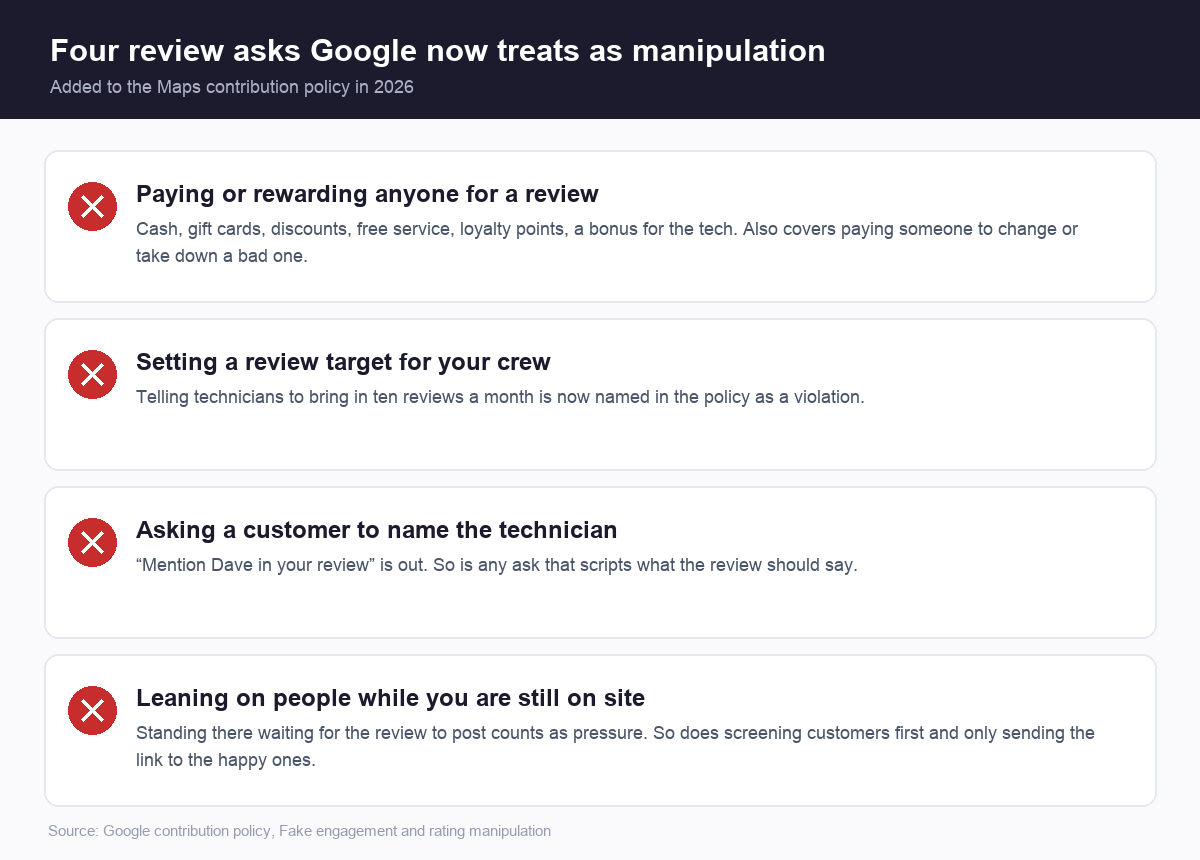
Read them one at a time, because each one maps to something restoration companies do every week.
No incentives, in any direction. Cash, gift cards, a discount off the deductible, a free duct clean, entry into a monthly draw, loyalty points. It also covers paying somebody to take down or soften a review they already left. This part is not new in spirit, but enforcement in 2026 is a different animal.
No review quotas for your team. Telling techs to bring in ten reviews a month is now named in the policy. So is any bonus structure built on review count.
No scripting what the review says. The line that catches most restoration firms is the one about asking customers to identify a staff member. “Please mention Marco” is out. So is “say something about how fast we got there”.
No pressure while you are on site, and no screening first. Google also prohibits discouraging negative reviews or picking out only the happy customers to send the link to. That is review gating, and it is enforced now.
You can read the full policy on Google’s contribution policy page. It is short. Print it and put it in the van.
Why restoration companies are more exposed than most trades
Three things about this trade put you closer to the line than a landscaper or a dentist.
The first is emotion. A homeowner who just watched you pull three feet of water out of a finished basement will say yes to anything you ask. That makes the on site ask feel natural and makes it very easy to cross into pressure without meaning to.
The second is the tech bonus culture. Restoration has run per review spiffs for years because it works. It is also the clearest violation on the list now, and the fix is not complicated: pay on the things that cause good reviews instead. First time fix rate. On time arrival. Callback rate. Same money, no policy risk.
The third is volume that arrives in bursts, which deserves its own section.
The storm week problem nobody warns you about
Most local businesses pick up reviews at a steady trickle. Restoration does not. A pipe freeze event or a named storm rolls through and you do forty jobs in nine days, then almost nothing for a month. If your review process is working, your profile shows exactly the pattern that automated spam systems are built to flag.
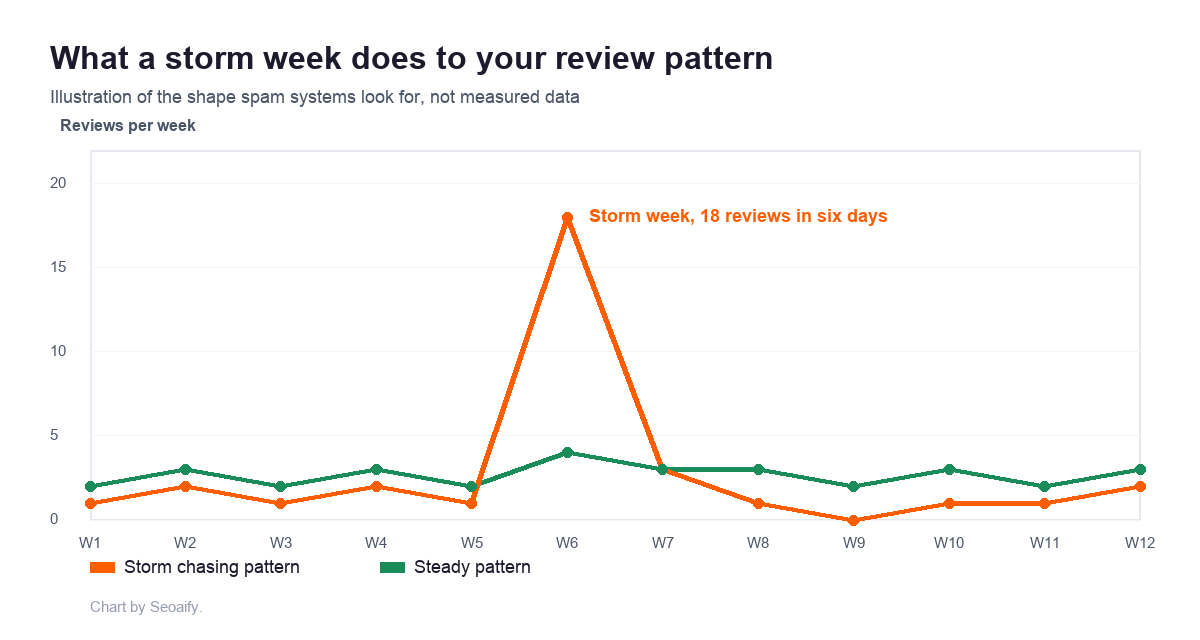
Google has never published a threshold, and anyone who tells you the exact number is guessing. What local search practitioners see over and over is that a sharp spike followed by silence gets a profile a much closer look than the same total spread over three months. Reviews get held back, some never publish, and in the worst cases the profile stops accepting new ones.
You cannot control when the water arrives. You can control how fast you push the asks out behind it. After a catastrophe week, stagger the requests over the following three or four weeks instead of firing all forty on the Friday. The reviews are just as real. They simply arrive in a shape that does not look manufactured.
Google is enforcing this with machines, not people
This is the part that changes the risk calculation. Google’s Maps trust and safety update, published on 16 April 2026, put numbers on how much of this is now automatic.
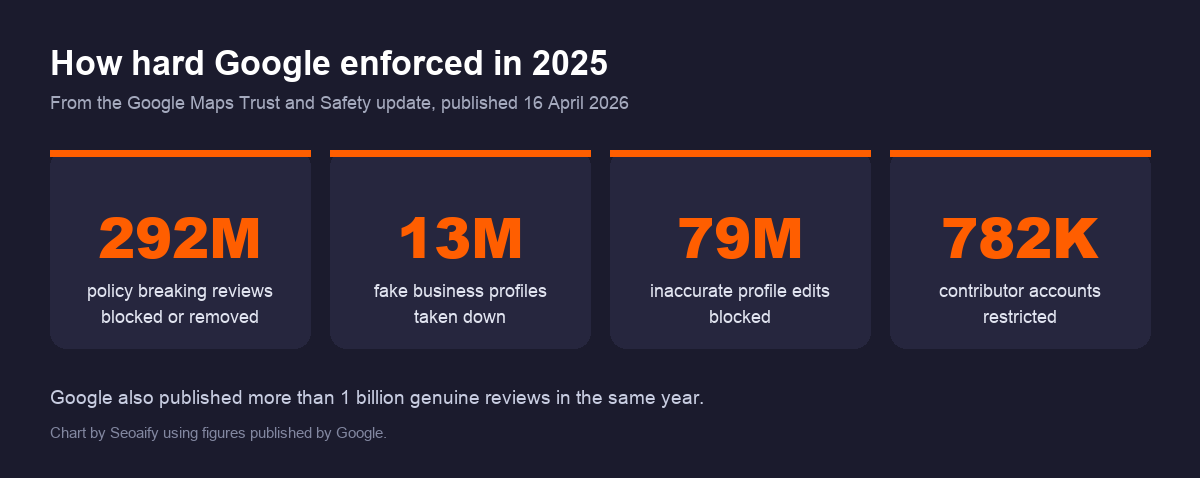
Google reported blocking or removing 292 million policy breaking reviews during 2025, up from 240 million the year before, alongside 13 million fake business profiles and 79 million inaccurate profile edits. It also restricted 782,000 contributor accounts and still published more than a billion genuine reviews. You can read the announcement on the Google blog.
There is no reviewer reading your situation and weighing intent. A pattern gets matched and an action gets taken, and you find out when the count on your profile drops. Restoration lives and dies on the Map Pack, so a profile that quietly loses eleven reviews loses ranking, and the phone goes quiet in a week.
A review process that stays inside the rules
The good news is that a compliant process is easier to run than the one most companies have now, because it takes the awkward part off the technician.
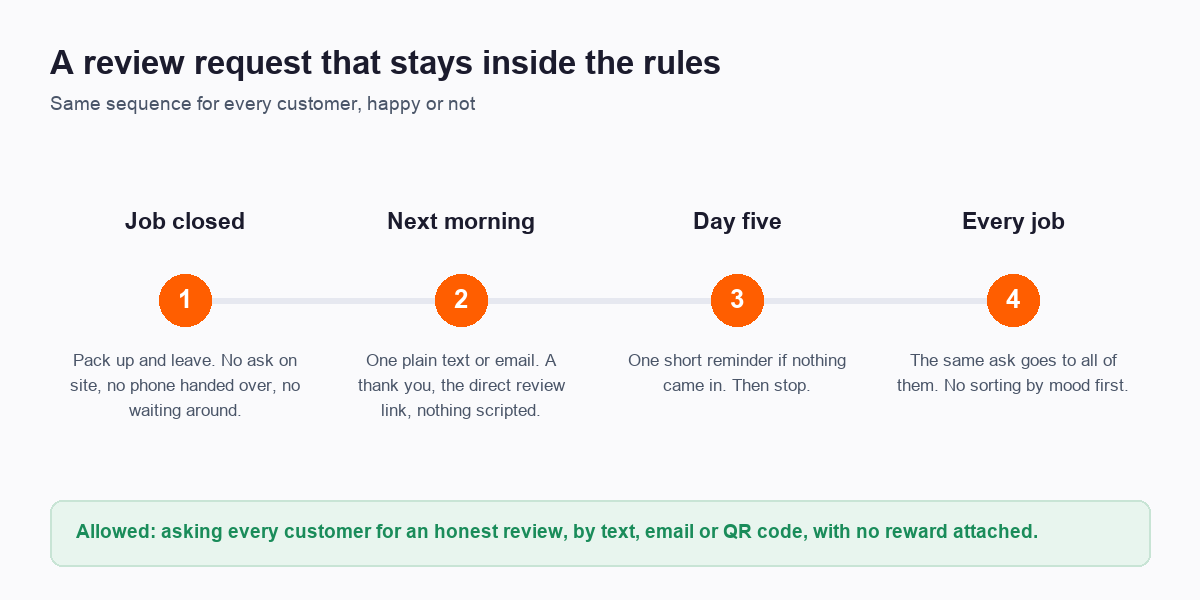
Four rules cover almost everything.
Ask after you leave, not before. One text or email the next morning with your direct review link. Nobody standing in the hallway waiting.

Ask everybody. Every closed job gets the same message, including the ones you suspect will sting. Sorting customers by mood before you send the link is the thing Google calls gating, and a 4.7 with a couple of honest three star reviews converts better than a suspiciously perfect five anyway.
Say nothing about what to write. No names, no keywords, no “if you were happy with us”. Ask for an honest account of how it went and leave it there.
Reply to all of them. Replies are not restricted, they are read by the next caller, and they are the cheapest trust signal you have. Our review management service handles the whole loop if you would rather not.
Worth saying plainly: none of this stops you asking. Google still allows you to ask for genuine reviews by text, email or a QR code on the invoice. The rules are about rewards, scripts and pressure, not about the request itself.
What to do if reviews start disappearing
Count first. Screenshot your review total weekly so you can tell the difference between a real removal and a bad memory. If reviews have gone, work through it in this order.
- Stop every incentive and quota today, including anything informal a branch manager runs. Nothing else matters until that is off.
- Pull your review request template apart and cut any line that suggests content, names a person, or sorts customers by sentiment.
- Check the profile basics that trigger separate problems: a business name with keywords stuffed into it, a category that does not match what you actually do, an address that disagrees with your website and your licence records. Our guide to optimising your Google Business Profile walks through each field.
- Slow the flow down for a month. Steady beats a comeback surge.
- If the profile itself is restricted or suspended, use the appeal form in the Business Profile dashboard and attach real proof of operation: licence, insurance, signage, a utility bill at the address.
Recovery is usually weeks, not days, and there is no phone number that speeds it up.
Questions restoration owners are asking
Can I still ask customers for Google reviews?
Yes. Asking is allowed and always has been. Send the request after the job, by text or email, with no reward attached and no instruction about what to write.
Is offering a discount for a review really banned?
Yes, and it covers anything of value, not just cash. Discounts, free add on services, gift cards and prize draws all count, whether the review is positive or not.
Can I pay technicians a bonus tied to reviews?
No. Review count targets and per review bonuses are both named in the policy now. Pay on service quality measures instead and the reviews follow anyway.
Why did my Google reviews suddenly disappear?
The common causes are an incentive or gating pattern, a sudden burst of reviews in a few days, reviews left from the same device or network, or the reviewer’s own account being restricted. Removals are automated, so nobody will email you an explanation.
How many reviews a week are safe after a big storm?
Google publishes no number. Judge it against your own history rather than a rule of thumb. If you normally see three a week, forty in nine days is a spike worth spreading out over the following month.
Where this leaves you
Nothing here stops a restoration company building a strong profile. It stops the shortcuts. The companies that get hurt over the next twelve months are the ones running a tech spiff they forgot about and dumping every storm job’s review into the same six days. The ones that win keep a plain ask, send it to everyone, and let it arrive at a human pace.
We do this for restoration companies all day. See what the Map Pack work looks like in practice, read more about local SEO for water damage and restoration companies, or send us your profile and we will tell you what is flagging it.
Published by the Seoaify Team. Top photo: Wes Warren on Unsplash.




2 Comments